If your mobile signal disappears during loadshedding, the regulator says it wants to fix the cause. The Pakistan Telecommunication Authority (PTA) has proposed a phased move of mobile towers to solar power, battery storage and hybrid systems, to cut diesel use and keep networks running when the grid goes down, according to reports in Business Recorder and TechJuice.
What PTA is asking for
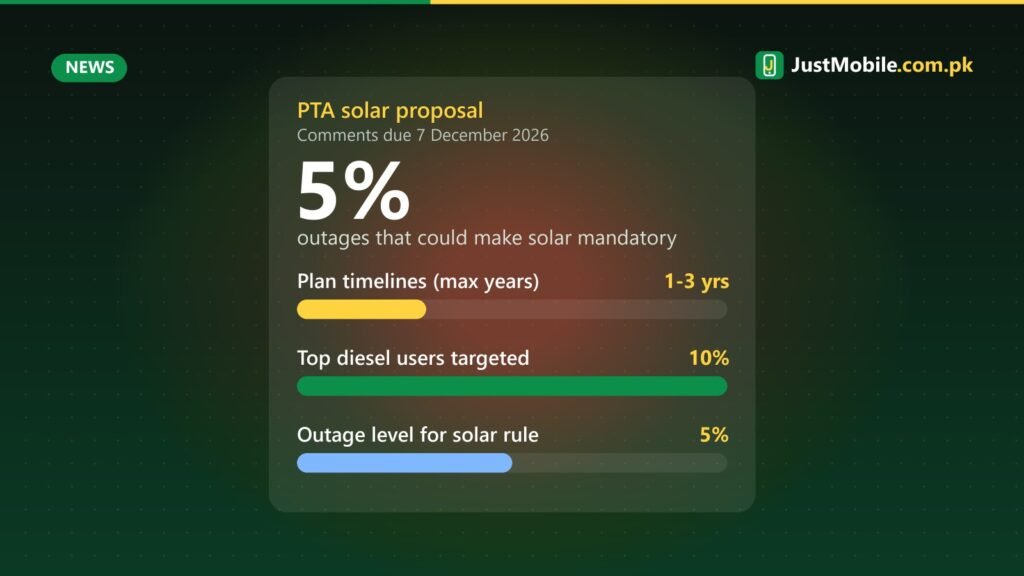
- Conversion plans: operators and tower companies should list sites with long power outages, check whether renewable power is practical there, and submit investment plans with one-, two- or three-year timelines.
- A possible rule: PTA wants feedback on whether solar should be mandatory at sites with monthly outages of 5% or more.
- Diesel cuts: the plan targets the 10% of towers (base transceiver stations) that burn the most diesel, with operators reporting current energy use, backup arrangements and grid availability.
- Night and cloudy days: PTA stresses that any new system must keep service running when solar output is low.
- Shared systems: it is also considering shared renewable power at sites used by several operators, incentives for energy-efficient operators and coordination with power-sector bodies.
Comments are due by 7 December 2026. Reports describe the framework as technology-neutral and industry-led: PTA is asking operators to propose targets rather than setting one figure for everyone.
Why it matters for your signal
Power is the biggest weak point of Pakistan’s networks. PTA’s own field checks found faulty batteries, broken generators and unreliable power at many sites; we reported last week that it inspected 226 more sites in two weeks. At the same time, Jazz, Zong, Ufone-Telenor and PTCL have asked the Prime Minister for industrial electricity rates, saying commercial tariffs for tower sites have risen about 197% since 2018.
The two ideas pull in slightly different directions: operators want cheaper grid power, while PTA is pushing them to depend less on the grid and on diesel. Solar with batteries costs more up front, but it can keep a tower alive through a long outage, which matters more as 5G sites draw more power.
What happens next
This is a consultation, not a rule. After 7 December PTA will review the comments before deciding whether to set mandatory targets. For users, the practical test will be simple: fewer “no service” moments during loadshedding, especially outside the big cities.
Sources: Business Recorder, November 2026; TechJuice, 24 November 2026.
0 comments