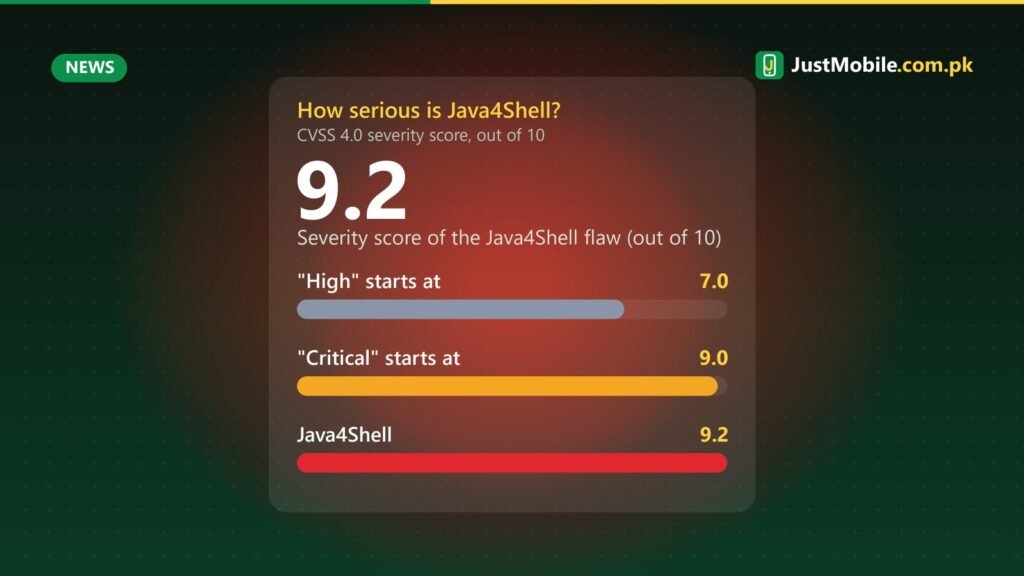
Pakistan’s National Cyber Emergency Response Team (National CERT) has issued a warning about a serious new security flaw in Java, nicknamed “Java4Shell” and tracked as CVE-2026-114938. It has a severity score of 9.2 out of 10 (CVSS 4.0), which puts it in the “critical” range. The warning, reported by ProPakistani on 19 November, is aimed at government departments, banks, software houses and other organisations that run Java on their servers.
What the flaw does
The bug is in the part of Java that decodes Base64, a very common way of packing data into text. A specially crafted piece of data can corrupt the computer’s memory and, in the worst case, let an attacker run their own code on the server without logging in. It was found by the security firm Calif and disclosed on 17 November.
It only affects certain machines: Java 17.0.6 and newer, from almost every vendor (Oracle, Amazon Corretto, Eclipse Temurin, Microsoft, Azul, Red Hat and others), running on x86-64 processors with AVX-512 VBMI, a feature of many recent Intel and AMD server chips. Computers with ARM64 chips, such as AWS Graviton servers and Apple silicon Macs, are not affected. Popular tools reported as vulnerable by default include Jenkins, Jira, Confluence and Keycloak.
Is my phone at risk?
No. Android apps do not run on the affected Java runtime: Android uses Google’s own Android Runtime, and phones use ARM chips, which are not affected. iPhones do not use Java at all. The risk is to the servers behind websites and apps, so the job of fixing it belongs to the companies that run them, not to phone users. As always, keep your phone’s apps and software updated, and use strong, unique passwords (https://www.justmobile.com.pk/nordpass-most-common-passwords-2026-123456/).
What organisations should do
- Update Java runtimes to the fixed versions released on 17 November, then restart Java services.
- Check bundled Java inside applications and appliances, which may stay vulnerable after the main Java install is patched.
- Prioritise internet-facing Java applications, and use a web application firewall to block malformed requests until patching is done.
- Temporary fix: National CERT also advises turning off the optimised AVX-512 Base64 feature where possible, and watching for suspicious activity.
National CERT has issued a steady stream of warnings this year; PTA alone sent 59 cybersecurity advisories to telecom operators in a year (https://www.justmobile.com.pk/pta-59-cybersecurity-advisories-telecom-operators-annual-report/).
Sources: ProPakistani, 19 Nov 2026; Qualys Threat Research, 17 Nov 2026.
0 comments