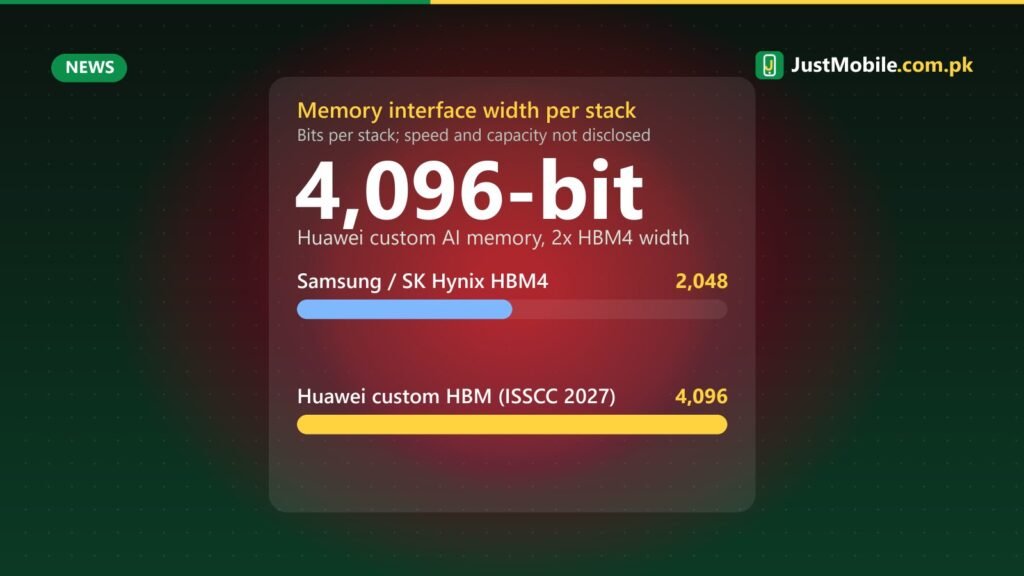
Huawei has designed a new type of AI memory that, on paper, is twice as wide as the best chips from Samsung and SK Hynix. According to Bloomberg, Huawei researchers will present a custom high-bandwidth memory (HBM) with a 4,096-bit interface at the ISSCC chip conference in San Francisco on 16 February 2027.
What Huawei has shown
- 4,096 data connections per memory stack, compared with 2,048 in the HBM4 chips that Samsung began shipping in February 2026. A wider interface lets more data move between the memory and an AI processor at the same time.
- 64 channels, built-in memory controllers and five layers joined with wafer-on-wafer hybrid bonding, according to the conference programme.
- Not disclosed: speed, total bandwidth, capacity, power use, who would manufacture it and when it could be mass-produced. Samsung’s HBM4 delivers up to 3.3TB/s per stack, so we cannot yet say whether Huawei’s design is actually faster.
Huawei needs its own memory because US export controls since December 2024 have cut it off from foreign HBM and much of the equipment to make it. The memory is meant for Huawei’s Ascend AI chips, not for phones.
Why phone buyers should care
HBM and phone memory are made in the same factories. As memory makers move production to the far more profitable AI chips, there is less ordinary RAM and storage for phones, and prices have jumped. That is why Samsung raised Galaxy A prices in Pakistan this month and why Xiaomi’s average phone price rose about 40% in a year.
Counterpoint Research has just updated its forecast. It now expects global phone shipments to fall 13.9% in 2026, slightly less than its earlier 14.3% estimate, but it has deepened its 2027 forecast from a 1.4% fall to a 6% fall, as reported by ProPakistani. It only expects a recovery of about 6% in 2028, when more memory supply arrives. We covered the earlier forecast here.
For Pakistani buyers, the message is the same: cheap phones with lots of RAM and storage are getting harder to find, and prices are unlikely to fall before 2028. If you need a phone soon, waiting for prices to drop may not pay off.
Sources: ProPakistani (citing Bloomberg), 27 November 2026; ProPakistani (citing Counterpoint Research), 27 November 2026.
0 comments